When an existing floor starts vibrating excessively and I propose a solution, clients always ask me the same question: “Will your solution actually work?”
The honest answer is that no engineer can ever know with complete certainty from calculations alone. Finite element models are indispensable, but they are still models built on assumptions. The true stiffness of connections, the influence of partitions, the contribution of finishes, the actual damping of the structure which is in reality often non-linear and amplitude-dependent and even the way occupants use the space all introduce uncertainty. However sophisticated the analysis, predicting the vibration performance of an existing floor will always involve assumptions and the predicted performance will be uncertain.
As a floor vibration serviceability consultant, I kind of got used to this inherent uncertainty over the years and can live with it. But it’s not for the fainthearted and, more importantly, there is no reason to take this risk anymore. I’ll explain how.
Standard approaches that cannot be tried
Indeed, why make a major investment based solely on a prediction when the structure already exists? Surely the obvious thing to do is to trial the proposed solution in situ and measure how it performs. That immediately reduces uncertainty and the associated risk.
Unfortunately, with standard floor vibration mitigation technology, that simply is not possible. The three commercially available approaches used for decades are: (1) structural modifications, (2) tuned mass dampers and (3) constrained layer damping.
Structural modifications remain the tried and tested traditional approach. Increasing stiffness by adding or stiffening beams or reducing spans by adding columns accompanied with increasing mass with deeper concrete deck can all be highly effective. However, they require major construction work. They are expensive, disruptive and permanent. They cannot be tested before committing to the works. The uncertainty of the performance remains, while the considerable financial and environmental costs are dead certain.
Tuned mass dampers are another proven solution. However, conventional TMDs are custom-designed for each location, typically weigh hundreds of kilograms hence difficult to handle in-situ, and require specialist installation and commissioning. They are not something that can simply be brought into a building, trialled for an afternoon and removed if they fail to meet expectations.
Constrained layer damping is also a feasible technology, but it is normally incorporated during construction, typically within the composite floor build-up between the top flange of the steel beam and the concrete slab. If it was not installed when the building was constructed, retrofitting it is, for all practical purposes, impossible.
Notice something? None of these solutions can be trialed before committing to them.
New approach
That is exactly where CALMFLOOR®, the novel fourth solution commercially available on the market since mid-2022, is different.
The trial itself is remarkably simple. A CALMFLOOR unit can simply be placed on the structural floor, connected and made operational. I can personally have a demonstration system running in well under an hour, and I am certainly not the fastest member of the demonstration team. Within minutes, the floor can be tested and the improvement measured on the actual structure before any commitment is made.
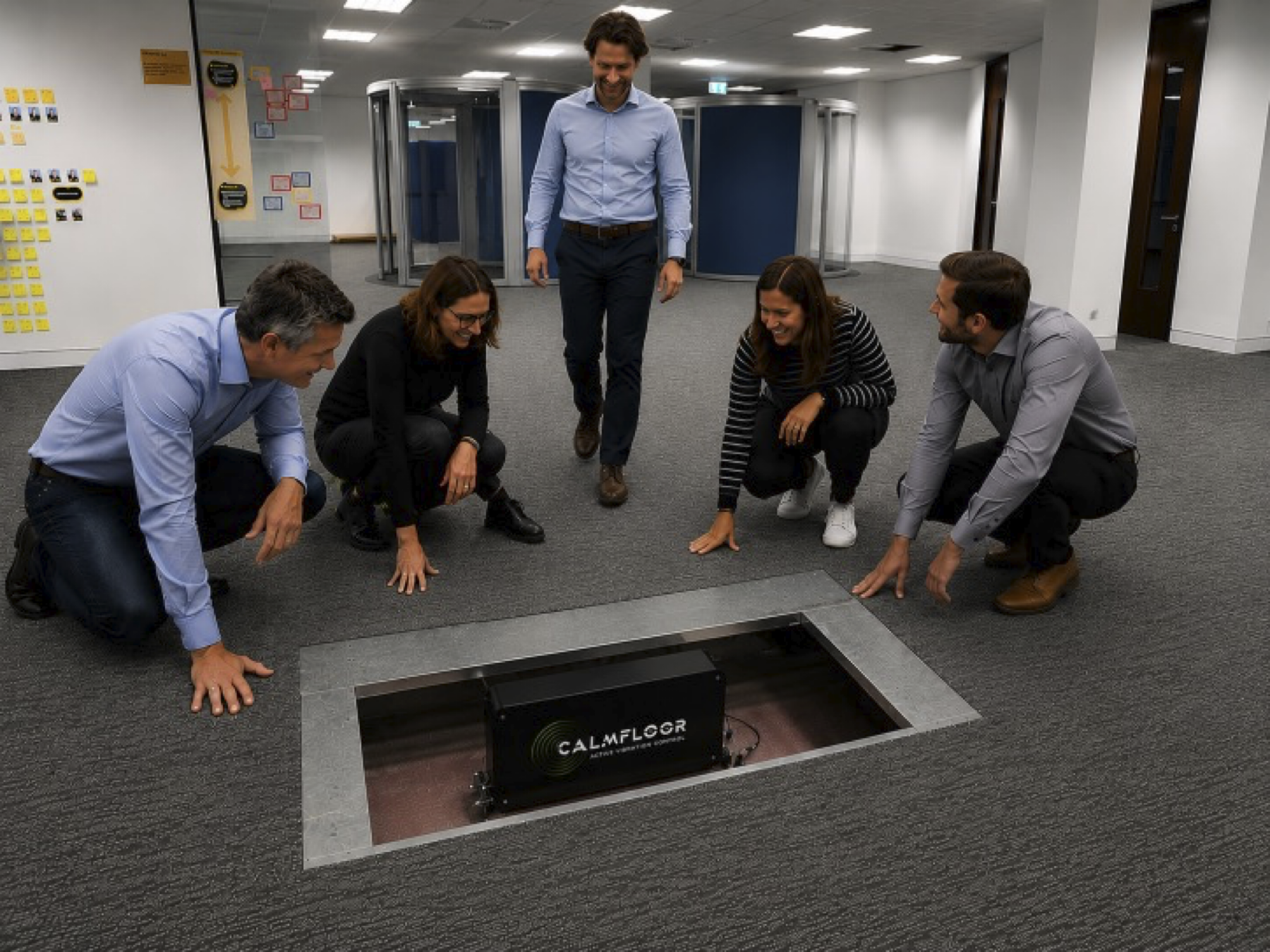
When the client decides to proceed, the permanent installation is equally straightforward. This allowed engineering and management decisions to be based on as-built measured performance rather than calculated prediction alone.
Moreover, I have personally watched two installers, neither of whom had ever even seen, let alone installed, CALMFLOOR before. They completed the permanent installation of three CALMFLOOR units by following nothing more than the installation manual. They mag-drilled just twelve holes (four per unit) into the webs of three secondary steel beams and completed the installation and commissioning in around four hours. Those three units (Figure 2) went on to control vibration across approximately 500 m² of long-span composite floor.
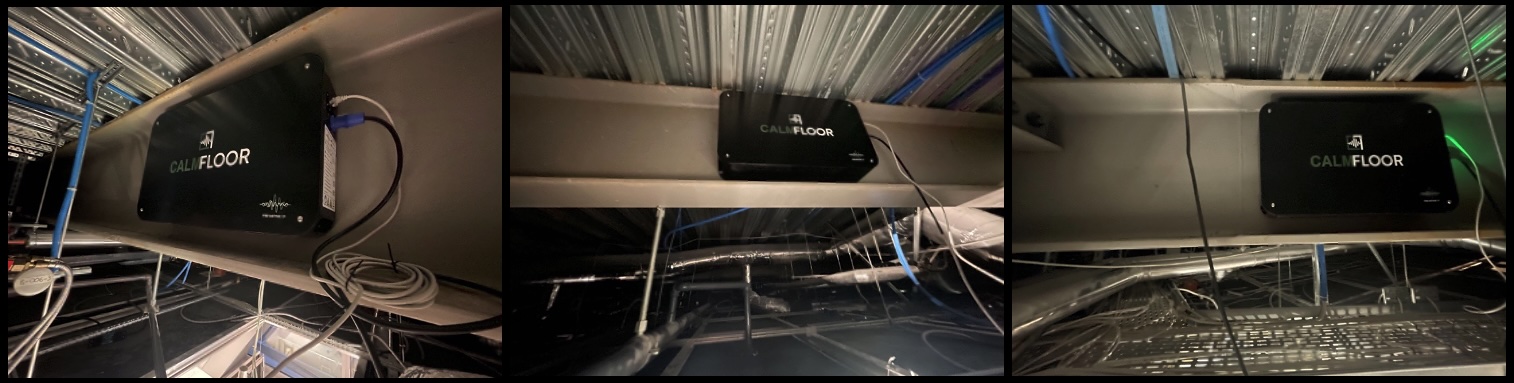
CALMFLOOR can be trialed in minutes and permanently installed in just a few hours with no disruption worth mentioning.
Key new option: try and buy
Perhaps the biggest benefit of this novel approach is for the client. They no longer have to rely solely on engineering calculations or promises. They can walk across their own floor, feel the improvement themselves and examine the measured vibration data.
Few engineering decisions inspire greater confidence than seeing the solution work before committing to it. As refurbishment of existing buildings becomes an increasingly important part of the construction industry, engineers are being asked more frequently than before to improve the vibration performance of floors in them. In that world, reducing uncertainty is just as important as reducing vibration itself.
How can that be done?
By adopting a simple engineering philosophy that has guided my research and consulting work for more than three decades: the best laboratory for a structural engineer is the real structure itself. Everything that matters in floor vibration can be measured if the floor structure already exists: natural frequencies, mode shapes, damping ratios, modal masses, frequency response functions and floor accelerations. These measured properties describe very accurately the real building, complete with all the complexity that no finite element model can ever reproduce perfectly.
Like other colleagues around the world for the last 70 years, I had no practical way of applying this try-and-test philosophy to floor vibration control currently commercially enabled only by CALMFLOOR. Today I do. Instead of asking clients to trust a prediction, I can invite them to join me for a couple of hours to experience the solution on their own floor before deciding to implement it or not. I believe that is exactly how floor vibration control should be practiced on existing floors in 21st century.