

A simple question
A recently published CALMFLOOR Grade A office case study has made me question yet again whether floor vibration design is focusing on the metric that actually matters to occupants.
Current floor vibration guidelines are based largely on vibration magnitude: does the floor exceed a prescribed response factor or peak acceleration limit under a worst-case resonant walking scenario?
Yet a monitored office floor that was widely perceived as lively exceeded the commonly accepted office limit of R=4 for only 11 seconds during an entire 12-hour working day. The higher limits used for offices of R=8 or 0.5%g were never reached.
How can a floor be perceived as lively when the accepted limits are almost never or never exceeded?
The elephant on the floor
Every floor vibration problem consists of three parts: the vibration source, the vibration path and the vibration receiver.
The source (walking) and the path (mass, stiffness and damping of the structure) are reasonably well understood and can usually be modelled with confidence. The receiver is different. In the case of office floors the receiver is a human being.
Humans are intelligent, adaptive and influenced by many factors beyond vibration alone. Predicting human response to vibration remains considerably more difficult than predicting structural vibration response.
This is perhaps why Gillian Browning recently argued in The Structural Engineer for a “third paradigm” in serviceability design, recognising that understanding the vibration receiver may now be the greatest challenge [1].
A different way of looking at vibration
The office floor in the CALMFLOOR case study had a dominant natural frequency near 5 Hz, close to the third harmonic of normal office walking at approximately from 1.6 to 1.7 Hz.
This does not necessarily make the floor problematic because the vibration response is high. It makes the floor problematic because normal walking is statistically more likely to excite it.
Floor human occupants do not experience a daily maximum vibration response. They experience hundreds of individual vibration events throughout the day.
Perhaps we should therefore be asking how often perceptible vibration occurs rather than how large the largest vibration event is.
The key insight from the CALMFLOOR project emerged not from conventional short-term vibration tests, but from long-term monitoring of how often different vibration levels occurred during normal office operation. Three CALMFLOOR units were installed to control approximately 500 m² of floor area and independently monitored over multiple working days with the units switched on during some days or off on other days.
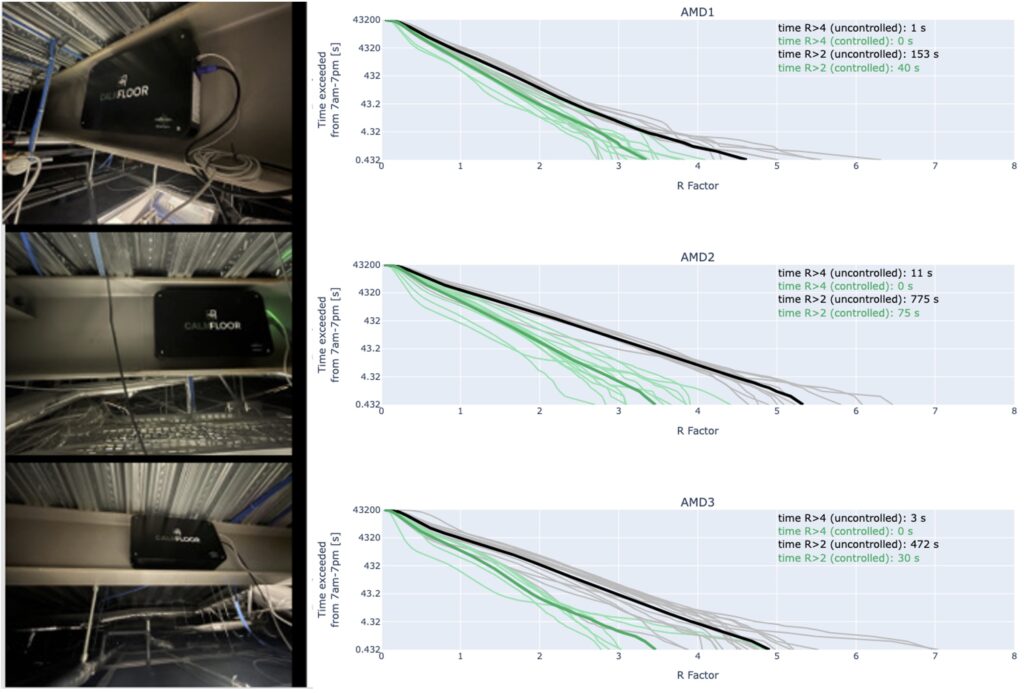
The resulting time-of-exceedance curves shown below quantify how long different response factor levels occurred at the three floor locations that occupants consistently perceived as lively when the floor was not controlled. They reveal a striking contrast between the very low occurrence of traditional office-limit exceedances (when R > 4) and the much more frequent occurrence of perceptible vibration events (when R > 2). This provides a unique insight into how floor vibration is actually experienced by occupants during day-to-day use.
What the monitoring revealed
The plot above that before (grey line for daily and black for average values) the installation of three CALMFLOOR units the exceedances of R>4 were extremely rare in normal floor usage – on average during only 11 s in the 12h day (43,200 s)!?
However, perceptible 1 s long vibration events (R>2) occurred much more frequently – 775 times during a typical 12h working day at one (AMD2) monitored location. With CALMFLOOR operational, that got decimated to approximately 75 events per day (light green line for daily and dark green for average values).
The floor users regarded the uncontrolled floor as excessively lively and the controlled floor as satisfactory.
In other words, CALMFLOOR managed to decimate the occurrence of perceptible vibration events that existing design procedures do not explicitly quantify.
Towards a new design philosophy
These observations are consistent with findings reported by Wong and Wesolowsky [2], who in 2019 documented three office floors that satisfied the Office (ISO) criterion yet still generated occupant complaints.
The implication is profound. Floor vibration serviceability may fundamentally be a problem of risk and exposure rather than simply vibration magnitude. A vibration event that is barely perceptible but occurs hundreds of times per day may be more important to occupants than a much larger event that occurs only once.
In conclusion, the most important question for all of us designing modern office floors may not be how much a floor vibrates, but how often people notice it.
[1] Browning, G. (2025). Viewpoint: Serviceability design – the third paradigm. The Structural Engineer, Vol. 103, No. 4, pp. 32–33, April.
[2] Wong, M.W.Y. and Wesolowsky, M.J. (2019). Why is My Coffee Cup Rattling: A Reassessment of the Office Vibration Criterion. Proceedings of the 37th International Modal Analysis Conference (IMAC XXXVII), Orlando, Florida.
Contact us