

Between 2020 and 2060, the world will need around 230 billion square metres of new floor area (Global ABC and UNEP, 2017). Floors also account for around 60% of the total structural mass of multi-storey buildings. These two hard facts alone should force a rethink of how we design building floors. Although floors are made of structural elements sized once to last for decades, they are in fact high-value assets that should be capable of changing to adapt to new uses over the life of a building.
Why?
Buildings tend to stay; tenants rarely do – particularly in commercial developments. The COVID-19 pandemic accelerated trends that were already underway: more rapid changes in occupancy, growing demand for high-quality indoor environments that support wellbeing and productivity and increasingly expensive building conversions. People spend around 90% of their lives indoors and are in constant physical contact with floors. No surprise then that floors sit at the centre of how buildings are experienced. They’re also at the centre of their ability to adapt.
Floors as long-term assets, not fixed liabilities
Long-span, open-plan floors remain the most effective way of enabling the floor’s utilisation flexibility. They allow architectural layouts to evolve without dense grids of columns, simplify service reconfiguration, and support changes of use. I saw long-span open-plan offices converted into laboratories, teaching spaces, gyms, residential accommodation and even – value-added high-end manufacturing. As the RIBA Journal noted in 2016 (Buxton, 2016), demand for long spans has expanded well beyond financial services into education, residential, and mixed-use buildings, reflecting a shift toward a long-term, optimally utilised asset.
However, this flexibility comes with well-known penalties. Longer spans typically result in reduced vibration serviceability and increased embodied energy. In many contemporary buildings – particularly those using lightweight steel, composite or mass-timber systems spanning 9-15 m and beyond – vibration, not strength or deflection, has become the governing design criterion.
Vibration as a building stressor
These floor systems often have natural frequencies in the low-frequency range most easily excited by human activity and most perceptible to occupants. As a result, floors that are structurally sound can still fail to meet vibration performance expectations.
Crucially, floor vibration is no longer simply a subjective comfort issue. It is increasingly recognised as a genuine environmental stressor for building occupants (Dovjak and Kukec, 2019) alongside temperature, lighting, acoustics and air quality. Unlike these other factors, vibration is often intermittent and difficult to attribute to a clear source, making it particularly disturbing. Research shows that excessive vibration can impair concentration, cognitive performance, and task accuracy – especially in knowledge-based work environments.
As expectations of indoor environmental quality rise, high-quality floor space can no longer be noticeably “lively” to footfall without undermining its value as an asset.
The limits of single-use design
The era of single-use buildings is well and truly over. Offices become private residences, retail becomes leisure and industrial buildings are repurposed as residential, cultural or educational spaces. Each change of use imposes potentially very different – and often more stringent – vibration demands. Floors that are designed narrowly for a single occupancy therefore risk becoming a constraint rather than an enabler of future change.
This is where floors should be understood as adaptable assets, with performance that can be dialled in, rather than fixed liabilities with which owners are stuck. A well-designed modern floor should be capable of accommodating significantly different vibration excitations as its function changes and, most importantly, of doing so without wholesale structural reconfiguration or replacement.
Embodied carbon versus adaptability: a false dichotomy
There’s a growing tension between calls for ever-shorter spans, which are often justified on the grounds of embodied-carbon reduction, and the need for adaptable, long-life buildings. Design guidance increasingly favours denser column grids and shorter spans to minimise material quantities. Yet these risk locking buildings into rigid layouts that are difficult to adapt and more likely to require premature demolition or major refurbishment. It’s a classic catch-22.
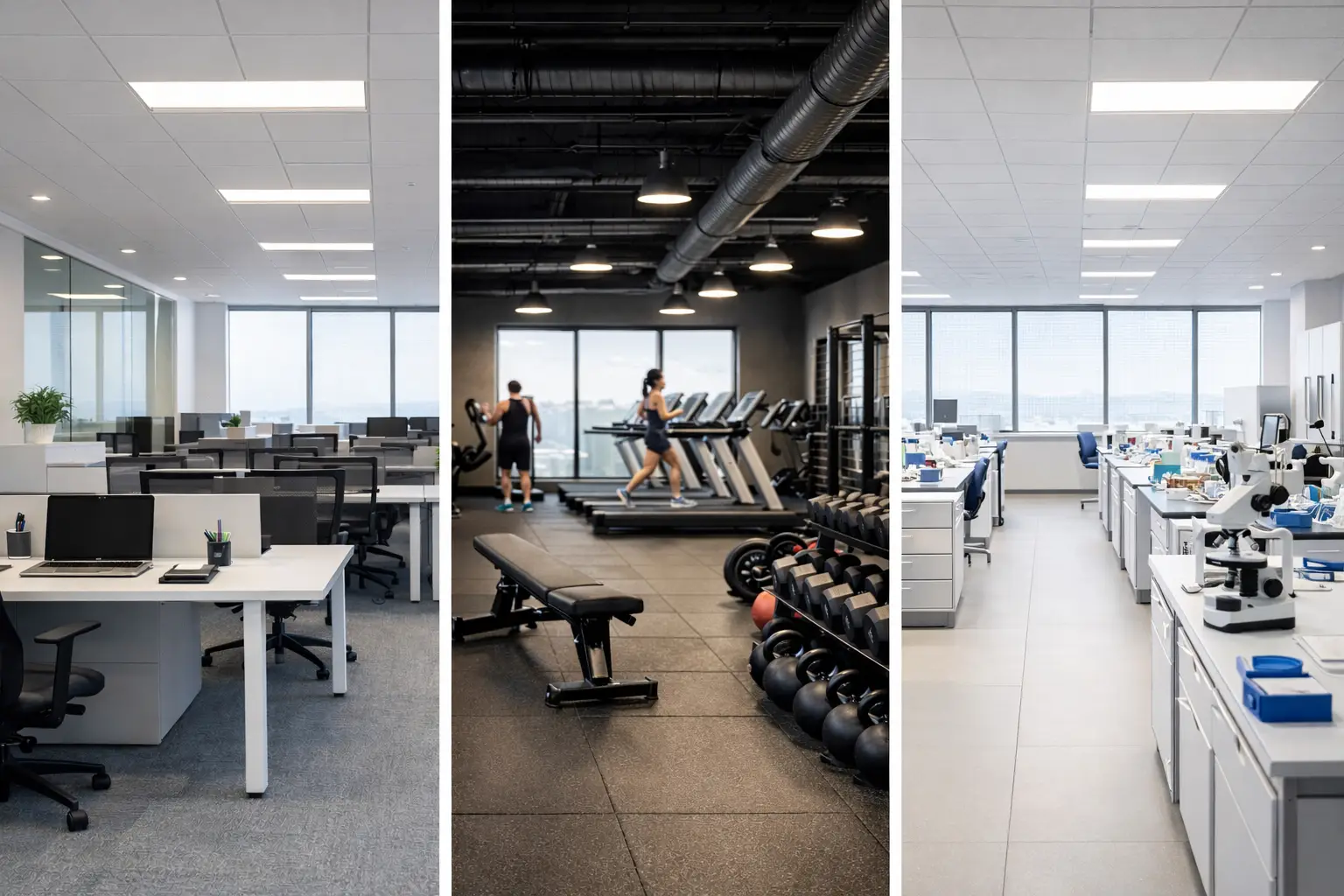 One floor structure must satisfy three very different vibration performance requirements.
As Buxton (2016) makes clear in the RIBA Journal, longer spans often carry a modest upfront cost premium but deliver disproportionate long-term value through flexibility and reduced future interventions. Embodied carbon cannot be assessed purely at the point of construction; it must be considered across the full lifecycle of the asset, including retrofit, conversion and eventual replacement. Floor vibration is a well-known reason why otherwise serviceable buildings become unfit for purpose – and it’s notoriously difficult to remedy during the expected life of a building.
Low-frequency floors: the norm, not the exception
Low-frequency, long-span floors with natural frequencies typically between 4 and 8 Hz are neither rare nor inherently flawed. They’re common in offices, teaching spaces, retail buildings, transportation hubs and assembly areas. Conservatively estimated, billions of square metres of existing and planned floor areas across the globe fall into this category.
These floors are not the result of poor design. They’re a direct consequence of architectural ambition and client demand for flexibility. The challenge is not to avoid long spans; it’s how to control the inevitable excess vibration – particularly during the repurposing that long spans are intended to enable.
Replacing mass and stiffness with damping
This is where a fundamental shift in thinking is required. Instead of relying solely on mass and stiffness, vibration performance can be transformed by introducing supplementary damping – particularly for floors often vibrating near resonance. CALMFLOOR active mass damper exemplifies this approach by providing targeted, active damping to low-frequency floors. Rather than increasing structural size or weight, it modifies the dynamic behaviour of the floor itself, often achieving at least factor-of-two reduction in vibration response required for clearly perceptible improvement in comfort and performance.
Crucially, this can be implemented post-construction. Existing buildings can be adapted to new uses easily and without structural deepening, added columns or invasive strengthening, all of which causes significant and expensive disruption. Active damping, in effect, replaces brute force with intelligence.
This reframes floor vibration performance as a service – analogous to air conditioning, elevators or lighting – available when needed, where needed and at the required level. An office floor can be converted into a lab with significantly reduced vibration levels, maintained for several years and later returned to office use without structural intervention. No other conventional and commercially available floor vibration-control solution offers this degree of reversibility and control – it’s an example of ultimate adaptability that’s seldom seen in civil structural engineering.
With CALMFLOOR, vibration performance can be altered with little more than a flick of a switch, fundamentally redefining how floors support changing patterns of use over a building’s lifetime.
The future – and the move towards adaptable floor structures
The future of floor design lies in adaptable floors that recognise vibration as a governing performance requirement throughout a building’s life, not just a one-time design hurdle.
In a world facing unprecedented demand for new floor area, tightening embodied carbon constraints, rapidly rising retrofit costs and fast-changing patterns of use, the question is no longer whether we can afford such adaptability, but whether we can afford not to build it in.
Floors are too widespread, too valuable, and too central to building performance to remain passive. The next generation of buildings will need to respond actively to change. Where floor vibration stands in the way of that future, active damping offers a way forward.
References
- Buxton, P. (2016). How far can you go? The RIBA Journal. 12 May 2016.https://www.ribaj.com/intelligence/how-far-can-you-go accessed 26 September 2024.
- Global Alliance for Buildings and Construction (GlobalABC) & United Nations Environment Programme (UNEP) (2017) Global Status Report 2017: Towards a zero-emission, efficient and resilient buildings and construction sector. UNEP, Nairobi.
- Dovjak, M. and Kukec, A. (2019). Creating Healthy and sustainable Buildings – An Assessment of Health Risk Factors. Springer Open.